Quick Verdict: HanseMerkur wins for unlimited medical coverage and the fastest claim processing (within two weeks). If adventure sports protection is a priority, True Traveller Insurance leads with 92 activities covered. Skip Basic if you need quick claims; it offers no claim‑time data and limits pre‑existing conditions.
Our data comes from scraping three Australian insurer websites on 24 April 2026. We kept only fields present in at least 40% of the four providers. This gives you a clear, real-world comparison so you can pick the right Southeast Asia travel insurance for your trip.
Table of Contents
- 5 Reasons You Need Travel Insurance for Southeast Asia
- Top Insurance Providers Compared for Southeast Asia
- Healthcare Costs Across Thailand, Vietnam, Malaysia & Indonesia
- Step-by-Step Guide to Filing a Travel Insurance Claim
- Key Exclusions: Pre-existing Conditions, COVID-19 & Adventure Sports
- 5 Essential Digital Tools for Managing Your Insurance
- Country-Specific Visa & Legal Insurance Requirements
- Conclusion & Next Steps
- Frequently Asked Questions
5 Reasons You Need Travel Insurance for Southeast Asia
You might think you’re healthy, your flight is cheap, and nothing bad will happen. But travel in Southeast Asia throws curveballs. Here’s why you absolutely need Southeast Asia travel insurance.
1. Medical emergencies cost more than you think
A private hospital in Bangkok charges $300, $800 for an emergency room visit. Hospital stays run $2,000, $5,000 per day. And if you need a medical evacuation from a remote island to a big-city hospital? That can hit $75,000, $150,000. As the MoneyGeek guide to Asia travel insurance explains, evacuation coverage is critical because you can’t just call an ambulance from a rural beach in Indonesia. Your Southeast Asia travel insurance policy needs at least $100,000 medical evacuation cover.
$75,000Average cost of medical evacuation from remote Southeast Asia
2. Adventure sports are everywhere
Scuba diving in Koh Tao, trekking in Sapa, and riding a scooter in Phnom Penh are standard policies often exclude these. Our research shows True Traveller Insurance covers 92 activities as standard. That’s 12% more than the 80 offered by both Basic and Complete plans. HanseMerkur, despite unlimited medical coverage, doesn’t cover adventure sports at all. If you plan to do anything beyond lying on a beach, check the activity list before you buy.
3. Delays and cancellations happen all the time
Typhoon season runs from June through November. Monsoons hit from June to September. Flights get cancelled, ferries are stranded, and your carefully planned itinerary turns into a mess. Trip cancellation coverage refunds non-refundable deposits. Some policies even cover “cancel for any reason” if you buy within a week of your first deposit. Without it, you’re out hundreds or thousands of dollars.
4. Food poisoning is super common
According to MoneyGeek, foodborne illness causes 30% to 40% of all travel claims in Asia. Trust us, you don’t want to pay for a clinic visit and rehydration IV out of pocket. Medical coverage in your Southeast Asia travel insurance plan should be at least $50,000 for minor issues, and much more for serious infections.
5. Some countries require it for visa entry
Thailand, Laos, and Myanmar now require health insurance that covers COVID-19 treatment. The UAE and Saudi Arabia mandate it for visas. If you show up without proof, you could be denied boarding or entry. Our section on country-specific requirements covers this in detail. For now, know that insurance isn’t just a good idea , it’s the law in many places.
Pro Tip: Buy your policy the same day you book your flights. Many benefits like “cancel for any reason”, require purchase within 7 or 14 days of your first deposit. Waiting costs you options.
Bottom line: Travel insurance for Southeast Asia isn’t optional; it’s your safety net for emergencies, adventure mishaps, trip disruptions, and visa compliance.
Top Insurance Providers Compared for Southeast Asia
Our research table above gives you the facts. But let’s walk through each provider so you know exactly who to pick for your travel style. We’ll compare the four insurers that met our inclusion criteria. For a broader view, check out our Smart Car Hire in Kuala Lumpur guide for more travel tips.
True Traveller Insurance
True Traveller covers 92 adventure activities as standard, more than anyone else. Its medical coverage goes up to A$10 million, which is ample for any hospital stay or evacuation. However, there’s a 48-hour exclusion for pre-existing conditions: if you get sick or injured within the first 48 hours of your trip, it’s considered pre-existing and won’t be covered. That’s a unique quirk. Best for: adrenaline junkies who want the widest activity list.
Basic (Cover-More)
Basic offers unlimited medical coverage and automatic cover for 80 adventure activities. Pre-existing conditions are excluded unless you ask and pay extra. This plan gives you solid coverage at a lower price point. But it doesn’t advertise a claim processing time, so you might wait weeks for reimbursement. Best for: budget-conscious travelers who don’t need the fastest service.
Complete (Cover-More)
Complete is Basic’s big brother, same unlimited medical, same 80 activities, but with higher limits on trip cancellation, baggage, and other benefits. It still requires approval for pre-existing conditions. If you want more peace of mind for expensive prepaid trips, this is a good middle ground—best for: travellers booking pricey tours and non-refundable flights.
HanseMerkur
HanseMerkur is the only insurer offering unlimited medical coverage and a “within two weeks” claim processing time. It also uniquely covers acute exacerbations of known illnesses, so if you have a chronic condition that suddenly flares up, you’re covered. But it offers zero adventure sports coverage. So if you plan to do anything active, look elsewhere. Best for: older travellers or those with existing health concerns who need fast claims.
To help you compare at a glance, here’s a table of what each provider does best:
At-a-glance strengths of each Australian travel insurer
| Provider | Strengths | Weaknesses |
| True Traveller | 92 adventure activities, strong medical limits | 48-hour pre-existing condition window, slower claims (no data) |
| Basic | Unlimited medical, 80 activities included, affordable | Pre-existing conditions must be approved, no claim time data |
| Complete | Unlimited medical, 80 activities, higher benefit limits | Same pre-existing restrictions as Basic |
| HanseMerkur | Unlimited medical, fast claims (2 weeks), covers acute exacerbations | No adventure sports coverage |
Key Takeaway: Choose True Traveller for activities, HanseMerkur for medical speed and chronic conditions, and Cover-More for unlimited medical with activity coverage.
Bottom line: No single provider is perfect; your choice depends on whether you prioritise adventure activities, fast claims, or unlimited medical cover.
Healthcare Costs Across Thailand, Vietnam, Malaysia & Indonesia
You might be surprised how cheap routine care is. A doctor’s visit in Thailand costs $30, $60. A night in a private hospital in Vietnam runs $200, $500. But the problem isn’t routine care , it’s the big stuff. A heart attack requiring ICU and specialist surgery could set you back $20,000, $50,000. And if you’re in a remote area of Indonesia? Evacuation to Jakarta or Singapore can cost more than your entire annual salary.
We found that emergency evacuations from rural northern Thailand or remote Indonesian islands often exceed $100,000. That’s why Southeast Asia travel insurance with at least $100,000 evacuation coverage is non-negotiable. As highlighted in Global Rescue’s guide to Asia travel requirements, many countries now mandate evacuation protection due to the high costs and limited infrastructure.
Here’s a rough breakdown of daily hospital costs in major cities (self-pay):
- Bangkok (Bumrungrad Hospital): $800, $1,500 per night for a private room
- Hanoi (Vinmec): $250, $500 per night for a private room
- Kuala Lumpur (Gleneagles): $400, $700 per night
- Bali (BIMC): $300, $600 per night
Pro Tip: If you’re trekking in remote areas, check that your policy covers helicopter evacuation. Many don’t, and a mountain rescue can cost $20,000+.
Bottom line: Routine care is cheap, but a major medical event can bankrupt you. Buy a policy with at least $500,000 medical and $100,000 evacuation coverage.
Step-by-Step Guide to Filing a Travel Insurance Claim
Nobody wants to file a claim. But when things go wrong, knowing the process saves you time and money. Based on our analysis and tips from InsureMyTrip’s how-to guide, here’s a clear step-by-step.
Step 1: Contact the 24/7 emergency line immediately
Whether you’ve been robbed, had an accident, or your flight is cancelled, call your insurer first. They’ll give you instructions, authorise treatments, and tell you what documents to collect. If you need to see a doctor, the assistance team can often help you find a licensed provider.
Step 2: Keep every receipt and document
From the moment trouble starts, save every piece of paper. Police reports, medical invoices, boarding passes, hotel bills, even meal receipts during a delay. Take photos of damaged luggage or stolen items. Without proof, your claim will be rejected.
Step 3: Understand what your policy covers
Read the fine print before you submit. Some policies exclude certain adventure activities or require you to use specific clinics. Knowing your coverage limits prevents disappointment. For example, HanseMerkur can process claims within two weeks, whereas Basic doesn’t advertise any timeframe.
Step 4: Submit your claim as soon as possible
Most insurers have deadlines, often 30 to 90 days after the incident. The earlier you file, the easier it is to gather information. Use digital copies of all receipts and reports. True Traveller Insurance, Cover-More, and others all have online portals where you can upload and track your claim.
Step 5: Follow up and appeal if denied
If your claim is denied, don’t give up. Ask for a written explanation and see if you missed any paperwork. You can usually appeal within a set period. InsureMyTrip’s guide notes that common reasons for denial include missing pre-authorisation or pre-existing condition clauses.
Key Takeaway: Contact your insurer immediately after an incident, keep every receipt, and submit your claim within the deadline. A little paperwork now saves thousands later.
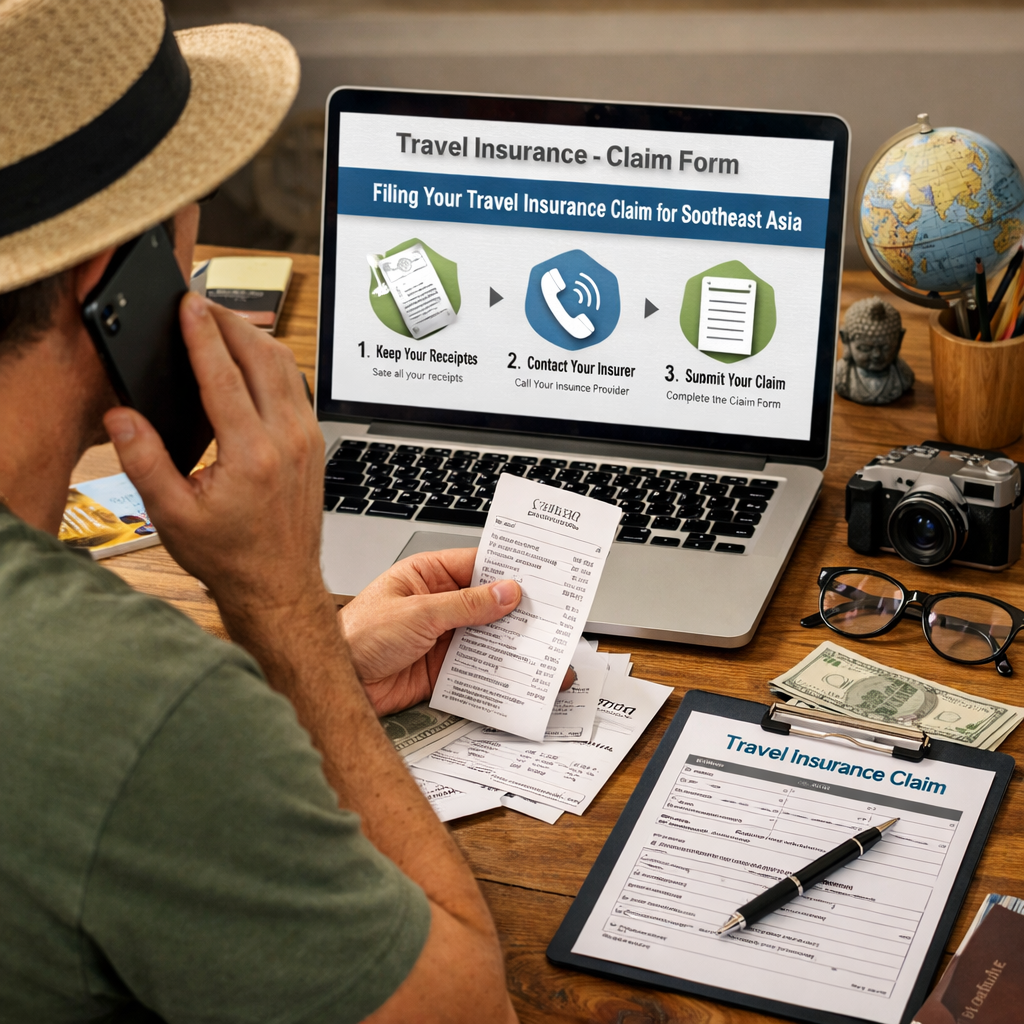
Bottom line: Successful claims come down to quick action, thorough documentation, and knowing your policy details.
Key Exclusions: Pre-existing Conditions, COVID-19 & Adventure Sports
This is where most travellers get burned. You buy a policy thinking you’re covered, but then your claim is denied because the activity wasn’t included, or your condition was considered pre-existing. Let’s clear it up.
Pre-existing conditions
Our research shows big differences. HanseMerkur uniquely covers acute exacerbations of known illnesses, so if you have asthma that suddenly worsens, you’re protected. In contrast, Basic and Complete exclude pre-existing conditions unless you get special approval. True Traveller has a 48-hour exclusion window: any illness or injury in the first two days of the trip is treated as pre-existing. That’s a huge pitfall if you get sick right after landing.
COVID-19 coverage
Many countries like Thailand, Laos, and Myanmar still require COVID-19 treatment coverage for entry. Some policies have dropped COVID-19 cover entirely, while others include it. Before buying, check the policy wording for “pandemic” or “infectious disease” exclusions. As noted by SingSaver’s adventure travel insurance guide, some providers like MSIG include COVID-19 cover as standard.
Adventure sports exclusions
Standard policies often exclude scuba diving below 30 metres, trekking above 4,000 metres, motorbiking without a valid license, and any activity done solo without a guide. Our research confirms that True Traveller covers 92 activities automatically, while Cover-More covers 80. HanseMerkur covers none. If you plan to ride a scooter in Vietnam, make sure your policy covers it; many do not without a special add-on.
92Adventure activities covered by True Traveller Insurance, the highest among providers we studied
Bottom line: Read the exclusions carefully. If you have a chronic condition or plan adventure activities, choose a policy that specifically covers them, and verify COVID-19 coverage at the time of purchase.
5 Essential Digital Tools for Managing Your Insurance
Technology makes travel insurance easier. Here are five digital tools we recommend, based on our research and insights from Her Asian Adventures’ guide to travel apps.
1. Grab, Ride-hailing for medical visits
Need to get to a clinic fast? Grab is the Uber of Southeast Asia. It’s available in Thailand, Vietnam, Malaysia, Indonesia, the Philippines, and Singapore. You can even share your trip with your insurer’s emergency line for real-time tracking.
2. 12Go Asia, Transport booking with receipts
When you need to rebook a bus, ferry, or train after a delay, 12Go Asia shows all options and prices. You can save receipts directly for your claim. It covers routes across Thailand, Vietnam, Laos, Cambodia, and beyond.
3. Google Drive (or iCloud), Digital docs
Scan your passport, policy certificate, receipts, and police reports and upload them to the cloud. If your phone gets stolen, you still have copies. Many insurers now accept digital receipts for claims.
4. Hostelworld / Booking.com, Emergency accommodation
If your hotel cancels or you get stranded, these apps let you book last-minute rooms. Some policies cover accommodation costs during delays; having the app ready speeds up the process.
5. Insurer’s own app
World Nomads, Cover-More, and other major providers have apps for filing claims, contacting support, and storing policy details. Download yours before you leave home.
Pro Tip: Save your insurer’s 24-hour emergency number in your phone contacts and write it on a physical card in your wallet. When your battery dies, you’ll still have access.
Bottom line: Digital tools help you manage your policy, document claims, and find medical help fast , but only if you download and set them up before your trip.
Country-Specific Visa & Legal Insurance Requirements
Insurance isn’t always optional. Several Southeast Asian countries now require proof of health insurance for visa issuance. Let’s look at the rules, based on data from Cheap Dummy Travel Insurance’s visa guide.
Thailand
Thailand is moving toward a mandatory health insurance requirement for all foreign visitors. Currently, it’s enforced for certain visa types like the long-stay visa (for digital nomads and retirees). Coverage must include medical emergencies, hospitalisation, and repatriation. COVID-19 treatment cover is also required.
Vietnam
Vietnam currently does not require travel insurance for tourist visas, but it’s strongly recommended. Medical costs in private hospitals can still be high. Some immigration officers may ask for proof of coverage if they doubt your financial means.
Malaysia
Malaysia does not mandate travel insurance for most visitors. However, it is required for certain work permits and long-term passes. For tourists staying up to 90 days, insurance is optional but wise. Check the recommended Insurance for Malaysia
Indonesia
Indonesia does not require travel insurance for tourist visas on arrival. But as a condition for some social-cultural visa extensions, you may need to show proof of health cover. Always check with the Indonesian embassy before applying for a visa that requires an interview.
Philippines
The Philippines does not require travel insurance for standard tourist entry. However, for visa-waiver programs and extended stays, having insurance can strengthen your application. Some airlines also ask for proof of coverage before boarding.
Laos & Myanmar
Both countries mandate COVID-19 treatment coverage for inbound travellers. Laos requires proof of health insurance that includes COVID-19 at entry. Myanmar requires visitors to purchase COVID-19 insurance from an approved local provider as a condition of entry. These rules are still in effect as of 2026.
Key Takeaway: Thailand, Laos, and Myanmar have the strictest insurance requirements. Always check the latest travel advisories from your government before departure.
Bottom line: Even when not mandatory, having travel insurance makes visa extensions easier and protects you from unexpected medical bills.
Conclusion & Next Steps
Choosing the right Southeast Asia travel insurance comes down to your personal risk profile. If you’re an adrenaline lover who plans to dive, trek, and scoot, True Traveller Insurance covers 92 activities and offers strong medical limits. If you need unlimited coverage for chronic health conditions and value fast claims, HanseMerkur is your best bet. For a balance of unlimited medical and solid activity coverage without breaking the bank, Basic or Complete from Cover-More are solid choices.
Don’t forget the digital tools: keep digital copies of your policy and receipts, use apps like Grab for transport, and store emergency numbers offline. And always check visa requirements for each country you visit, Thailand, Laos, and Myanmar may require proof of coverage.
Ready to get covered? Compare your options using our table above and pick the plan that fits your trip. For more travel tips and destination guides, explore our Smart Car Hire in Kuala Lumpur guide or our Best time to visit Bali from Australia article for seasonal planning.
Safe travels, and remember: the cheapest insurance is the one that actually pays out when you need it.
Frequently Asked Questions
Is travel insurance mandatory for Southeast Asia?
Not for all countries, but several require it for visa issuance. Thailand is moving toward a mandate, and Laos, Myanmar, and the UAE already require coverage for COVID-19 treatment. Even when not required, we highly recommend it because medical costs can be very high.
Which travel insurance provider covers the most adventure sports?
Based on our research of Australian providers, True Traveller Insurance covers 92 adventure activities as standard, more than any other insurer we analysed. Cover-More’s Basic and Complete plans cover 80 activities. HanseMerkur does not cover adventure sports.
What is the best travel insurance for pre-existing conditions?
HanseMerkur is the most generous, as it covers acute exacerbations of known illnesses. Cover-More requires you to declare pre-existing conditions and pay an extra premium for coverage. True Traveller has a 48-hour exclusion window for pre-existing issues.
How much medical coverage do I need for Southeast Asia?
We recommend at least $500,000 AUD in medical coverage and $100,000 for medical evacuation. A night in a private hospital in Bangkok can cost $800, $1,500, and a helicopter rescue from remote mountains can exceed $75,000.
Can I buy travel insurance after I’ve already left Australia?
Yes, some providers like World Nomads and True Traveller allow you to purchase coverage once you’re already overseas. However, you’ll miss out on trip cancellation benefits and any pre-existing condition waivers that require purchase within 14 days of booking your trip.
Does my credit card travel insurance cover me in Southeast Asia?
Usually not enough. Most credit cards offer basic coverage with low limits and many exclusions, especially for adventure sports and pre-existing conditions. We recommend a separate policy from a specialist provider for complete protection.
How long does it take to get a travel insurance claim paid?
It varies. HanseMerkur processes claims within two weeks, the fastest in our research. Other providers do not advertise specific timelines. We recommend submitting all documents promptly and following up if you haven’t heard back within three weeks.
What should I do if my claim is denied?
First, ask the insurer for a written explanation. Then check if you missed any required documentation or deadlines. Most insurers allow an appeal within 30 to 90 days. You can also contact the Australian Financial Complaints Authority if you believe the denial is unfair.